
“We were lucky. When I was growing up my parents and grandparents took care of everything. We didn’t realize. These kids do not have that much of flexibility in this century. My check split before I even touched it. You need to put money aside for vacation, for bills, for gifts. At the end of the day you have a dollar left.”
– Mother of a 4th grade student at PS 15.
Equitable Communities conducted interviews with the parents to evaluate the in-home learning effectiveness of our program, Money Box and collect the families’ feedback. In those meetings, parents emphasized how they wanted their children to understand the importance of savings, to learn how to actually start saving and to know the advantage of financial restrain in an increasingly complex and treacherous financial climate.
The parents expressed a desire to participate with their children in financial learning through workshops, through the Money box and especially through a savings game that is based on the reality. We therefore created a savings game/plan with the help of a grandmother and a parent coordinator present at the meeting. Parents feel that this kind of learning can have a major impact on their lives and their children’s.
Description of the Savings Workshop:
 Equitable Communities has created and developed a Financial Literacy Collaboration Center in PS 15’s library, which gives students and families access to financial resources: the Moneybox can be checked out and there are a number of other financially-themed books and games. The “Create a Piggy” Parent/child workshop, which took place on April 4th, 2014, was our first workshop since the creation of the FLCC and 35 children showed up with their parents. We had only ordered 24 piggy banks because we did not expect such a huge turn out and as Ms. Madison, the principal, pointed out: “It’s never a good thing to run out of piggies”.
The workshop was divided into two parts:
During the first part, Mrs. Gapp invited children to sit with us and read to them the Dollars and Sense Bernstein Bear book and interacted with them about the concept of savings and how to make money around the house to start saving a little bit each week. We showed them how to use a piggy bank, using the play money from the Moneybox.
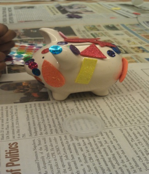 The second part was, needless to say, the main attraction of the workshop: decorating the piggy banks! We handed them out and provided art supplies (stickers, markers) for them to decorate the piggies with. There was a high degree of participation and the atmosphere was full of energy. We were pleased that there was a high degree of interaction between the parents and their children about each topic in the workshop. The workshop was a proof that financial education can be fun.
Description of Savings Game:
During our interviews with families on their use of the Moneybox, the most requested item was a savings game/plan that would encourage their children’s interest and ability at savings. They suggested combining both short term savings for special treats and long term savings such as for college. We are currently developing the savings game, based on PS 15’s parent coordinator’s suggestion of a savings game tracker.
 The game consists in identifying a goal that the child wants to reach, such as saving $10 to buy a new toy and working towards that goal, using the savings game tracker.
When the Kent brothers started the Marketplace Project in 2007, they were strongly influenced by their banking experience in 3rd, 4th and 5th grade. Students were given passbooks at the bank and every Friday, money was collected. At the end of the year, they were invited to the bank’s boardroom to hear what was being done with their money. They believe this experience contributed to their success in the finance industry and to their lifelong interest in financial literacy.
We are hoping that using a passbook would assist the fun aspect of the game. For example, each time the child deposits or withdraws money to/from his piggy bank, he or his parent will use a self-inking stamp on his booklet. We think that this will be a good method to keep track of the amount that goes in and comes out of the piggy bank and to facilitate a meaningful activity for parents and children.
Description of College Saving Plan:
Again, based on parent preference, we are also introducing a long-term savings plan for college. We contacted New York State’s NY 529 College Saving Program to find easy ways to sign people up for the formal college savings plan and to host a workshop with parents at PS 15 with their help. The Program agreed to collaborate with us starting the new school year.
Currently, we are looking for bank partners to promote safe banking. Once this is set up, we will work with our local partners that would match savings for college as an incentive. The child would own 2 piggy banks so as not get confused: one for short-term savings and the other one for college savings. If the parents decide to open a college savings account, the money can be transferred from the piggy bank to it. Facilitating this kind of collaboration between parents and school and bringing children who needs the most of all resources motivates us to develop this new program because we believe that financial skills should not only be a part of the school curriculum but should also be part of the child’s daily life.